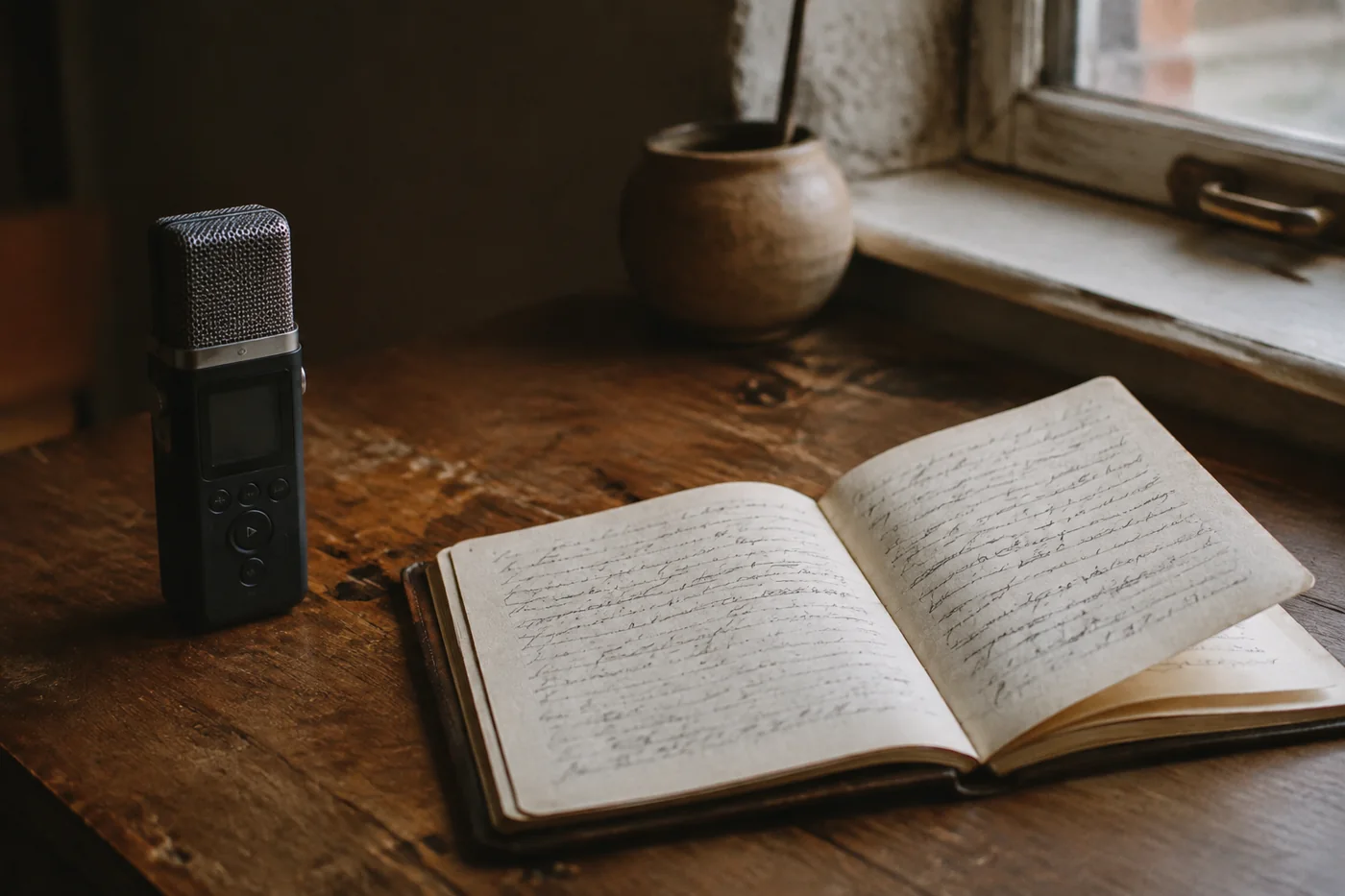
Hear it while it was happening.
Two selected recordings from the change itself. The entries below summarise other moments from the archive. Strong language is left in.
7 February 2024 · An unfiltered diary entry2:14
Day one: this doesn’t feel like me
Captions appear here during playback.
Read the transcript
Lightly edited for readability. Diary recordings contain strong language. These are my words at the time.
So, this is day one of trying to get used to changing the way I speak. Because I don't think this is meant to be the normal way. Although, after 37 years, it certainly feels very foreign, switching to one I know that I have. It sounds normal in recordings, but it really freaks me out when I try and use it. So I am trying to expose myself to it every day, in order to try and acclimatise. So, here goes. So this is what I normally should sound like. It sounds very strange. The dog's looking at me like, “What are you doing?” “Who are you?” That's kind of how I feel as well. So it just feels very strange, talking the way I haven't spoken like before. Feels like I can't control it very well. It feels very deep, very resonant, very powerful. Just extremely unfamiliar. The dog's still looking at me like, “What the fuck is that noise?” And, yeah, sorry.
Archived 6 March 2024 · Still in transition2:31
A month later: switching between voices
Captions appear here during playback.
Read the transcript
Lightly edited for readability. Diary recordings contain strong language. These are my words at the time.
So I wanted to give you a voice sample of what I normally sound like. So this is the way I've been speaking for the last 25 years. I'm in a relatively quiet environment at home, where I'm comfortable. And my voice isn't tired today. But this voice can change quite a lot once it gets tired, or once I'm in an environment that's quite loud, because I can't shout with it. And if I do shout, it just goes higher and higher in pitch. But this is the voice most people know me as using. It is quite difficult to use, and you notice it especially when you switch to the other voice. You can definitely feel the strain. And then this is the other voice, which I'm supposed to be using. You can see that I can switch to it quite easily. It's not difficult. But this one, I don't have to strain. It's quite natural. I can shout in it. I can sing in it. There's a lot of volume. It's more stable, if you listen to it. But this is the voice that is supposed to be there, but hasn't been. So you can imagine it's going to take a lot of adjusting to get used to speaking like this, from speaking a certain way for 25-odd years. This one feels a lot louder in my head. It feels very different. It feels like a different person, almost. I'm getting more and more comfortable using it at home by myself, but I find when I try to use it in front of other people, I just feel really embarrassed. I'm not sure why, because when you listen to recordings, it sounds perfectly fine. This is what a 37-year-old guy should sound like. You know, there's nothing crazy about it. But using it, to me, feels so strange and uncomfortable. Not physically uncomfortable, but mentally and emotionally uncomfortable. So, yeah, I've got a bit to work on. And hopefully I will eventually be speaking this way, because clearly this is the more normal, natural way to be speaking.
Dates in the archive are upload dates unless the recording itself names a date. Day numbers are the more reliable timeline.
Open an entry to read a condensed account of what I was thinking then and how I understand it now. These summaries are paraphrases, not verbatim transcripts.
01Baseline05 Feb 2024Two voices. One passage.
What I thought then
Rainbow Passage recordings in my lower and falsetto voices, archived together.
Looking back
This is where the archive begins: two voices that were both mine, but felt very different to use.
02Day 107 Feb 2024Normal on playback. Alien in my head.
What I thought then
“Very deep, very resonant, very powerful, extremely unfamiliar.”
Looking back
I already thought the recording sounded normal. That didn’t make speaking feel normal.
03Day 613 Feb 2024The dog stopped looking at me weird.
What I thought then
“The dog stopped looking at me weird which is good because that was awkward.”
Looking back
Voice acting and messing around let a bit of personality come through. Not every recording was a crisis.
04Day 715 Feb 2024My chest feels like a bass speaker.
What I thought then
The vibration feels far stronger than I expect. Later I compare the sound with a tweeter and a subwoofer.
Looking back
The early recordings keep returning to physical sensation and internal sound. Those were the things I couldn’t ignore.
05Day 815 Feb 2024Why change? Because I want to be heard.
What I thought then
Pubs, cafés, beaches, concerts, phone calls. I talk through the places where my voice could not project.
Looking back
The diary connects the practical limits of my voice with years of social avoidance.
06Day 916 Feb 2024I run out of patience.
What I thought then
“It sounds normal in recordings, it doesn’t sound normal in my head and it doesn’t feel normal.”
Looking back
This recording is more than an hour of anger and hopelessness. I couldn’t reason my way out of how unfamiliar it felt.
07Day 1018 Feb 2024Motocross makes the difference obvious.
What I thought then
My habitual voice cuts out. The lower voice carries over air conditioning and engine noise.
Looking back
This was a practical difference I could feel. Getting heard was suddenly easier.
08Day 1524 Feb 2024Twenty out of a hundred. Still progress.
What I thought then
Chest vibration is fading. The voice is less monstrous, but comfort is only ‘20 out of 100’.
Looking back
Less unfamiliar was enough to notice. I was still a long way from comfortable.
09March06–27 Mar 2024Other people start hearing it too.
What I thought then
Direct switching, recordings for others and conversations over Discord.
Looking back
I’m starting to use the voice around people while the internal sound is still catching up.
And then it became ordinary.
The recordings end in March. The memoir follows what came next: using the voice around other people and gradually thinking about it less.
The story after the recordings